Most Indian children can begin phonics learning as early as 2–3 years through playful, activity-based programs. The ideal structured phonics starting age is 3-4 years for nursery kids, and 4-5 years for LKG and kindergarten children. Early exposure to phonics sounds builds strong reading, spelling, and communication skills that benefit children throughout school.
One of the most common questions parents ask us at Phonics World Pune is: "What is the best age to start phonics for my child?" There is no single right answer, but there is a well-researched range, and knowing it can give your child a significant head start in reading, speaking, and language development.
What is the best age to start phonics in India?
Research in early childhood education, supported by India's National Education Policy (NEP 2020) focus on Foundational Literacy and Numeracy (FLN), shows that phonological awareness, the ability to hear and manipulate sounds — develops naturally between ages 2 and 5. This is the ideal window to introduce structured phonics learning.
At Phonics World Pune, we have worked with children since 2012 and observe that children who begin phonics between ages 2.5 and 5 develop stronger reading fluency, better spelling accuracy, and greater confidence in communication compared to children who begin later.
Why early phonics learning matters for Indian children
Indian children face a unique language learning environment, many grow up with English, Hindi, and a regional language like Marathi being used simultaneously at home and school. Phonics provides a structured, sound-based method that works across all three languages, helping children decode written words rather than rely on memorisation.
- Improves reading fluency and comprehension in English, Hindi, and Marathi
- Builds clear pronunciation and confident speaking skills early
- Expands vocabulary and strengthens foundational literacy
- Improves spelling accuracy and word recognition for school subjects
- Develops communication confidence that supports all academic areas
- Creates a strong base aligned with NEP 2020 Foundational Literacy goals
Signs your child is ready for phonics classes
Every child develops at their own pace, but these are the most reliable signs that your child is ready to begin a phonics program:
- Enjoys storybooks, rhymes, and listening to songs
- Can recognize some alphabet letters by sight
- Repeats sounds, words, and simple phrases they hear
- Shows curiosity about books, signs, and written words
- Listens attentively during storytelling activities
- Tries to "read" by pointing at words or pictures
If your child shows 3 or more of these signs, they are likely ready to begin an age-appropriate phonics learning program. A free demo class at any Phonics World Pune branch is the best way to confirm readiness.
How to support phonics learning at home
Parents are a child's first and most important teacher. These five daily activities take less than 15 minutes and meaningfully reinforce what children learn in phonics class:
Read together every day
Reading storybooks aloud builds listening skills, vocabulary, reading confidence, and a love for language. Point to words as you read to connect spoken sounds with written letters.
Practice letter sounds — not letter names
Say "the sound mmm" rather than "the letter em." Phonics is built on sounds, not letter names. This distinction is especially important in Hindi and Marathi phonics where the sound-symbol relationship differs from English.
Sing rhyming songs and nursery rhymes
Rhymes naturally develop phonological awareness — the ability to hear, identify, and manipulate sounds — which is the core cognitive skill underlying all phonics learning.
Play letter sound matching games
Hold up objects and ask "what sound does this start with?" Simple games build phonemic awareness faster than formal exercises.
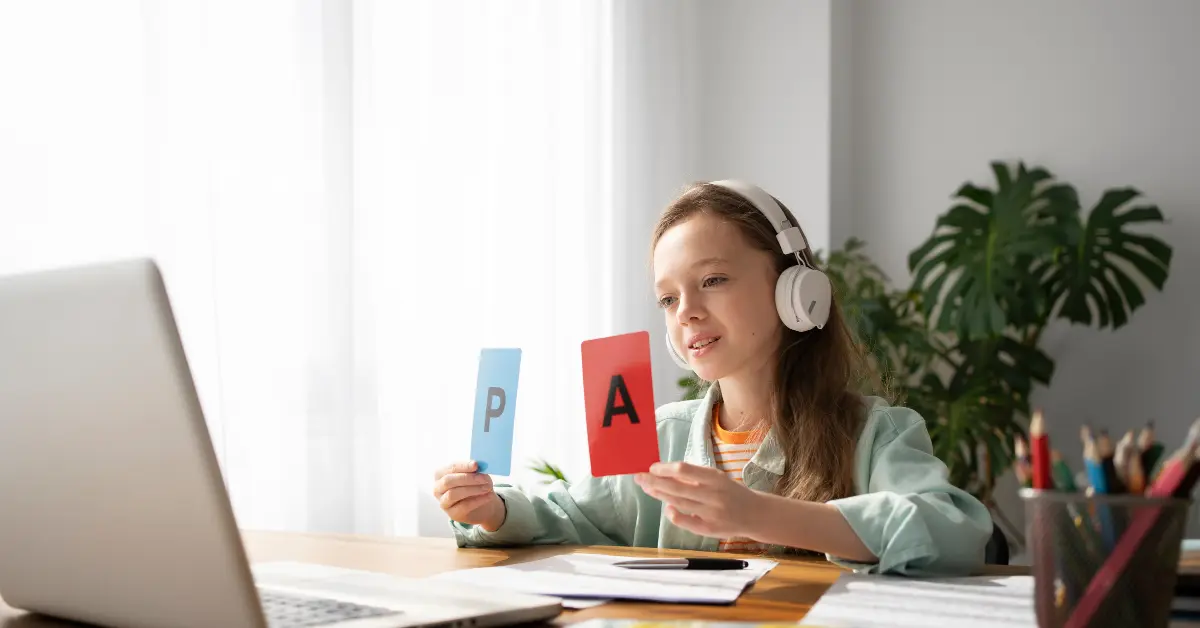
Use alphabet flashcards interactively
Visual + verbal + tactile learning together (seeing the card, saying the sound, tracing the letter) creates multi-sensory memory that children retain far longer than single-mode learning.
Frequently asked questions
What age should a child start phonics in India?
Most Indian children can begin phonics as early as 2 years through play-based activities. A structured phonics program is typically introduced at 3–4 years for nursery children. The earlier children start, the stronger their reading and communication foundation becomes.
Is it too late to start phonics at age 6 or 7?
No. Children in Class 1 and Class 2 (age 6–8) benefit significantly from our Phonics Intermediate program, which addresses reading gaps, spelling weaknesses, and comprehension skills aligned with school curriculum requirements.
What is the difference between phonics and reading classes?
Phonics is the method — it teaches children how to decode written words by connecting sounds to letters. Reading is the outcome. Phonics is the structured approach that leads to independent, fluent reading. Not all reading classes use phonics; Phonics World Pune uses structured synthetic phonics across all programs.
Does Phonics World Pune offer Hindi and Marathi phonics?
Yes. We are one of very few centres in Pune offering structured phonics in English, Hindi, and Marathi under one roof. Hindi phonics starts from age 5+ and Marathi phonics from age 5+, using the same structured sound-based learning approach as our English programs.
Are online phonics classes available for young children?
Yes. We offer both online and offline phonics learning programs at Phonics World Pune depending on batch availability and your child's learning preference. Online classes are available for children aged 3 years and above.
About the author
Dhwani Kapadia Desai is the co-founder of Phonics World Pune, established in 2012. With 13+ years of experience in early childhood phonics education, she has helped 500+ children in Pune build strong reading, speaking, and communication skills through structured phonics programs.