Phonics teaches children to read by connecting letter sounds to build any word — even ones they've never seen. The traditional alphabet method teaches children to memorise letter names and whole words by sight. Indian classroom research and NEP 2020's Foundational Literacy and Numeracy (FLN) mission both point in the same direction: phonics produces faster, more independent readers, while the alphabet-memorisation method leaves many children still struggling to decode simple words years into school.
If you're a parent in Pune, you've probably had this exact thought: "My child already knows A-B-C-D. They go to an English-medium school. Why would they need a separate phonics class?"
It's a fair question — and it's the single most common objection we hear at Phonics World Pune. The honest answer is that knowing the alphabet and being able to read are two completely different skills, taught in two very different ways. This article breaks down exactly how the two methods differ, what the research actually shows, and how to tell which one your child needs right now.
What Is the Traditional Alphabet Method?
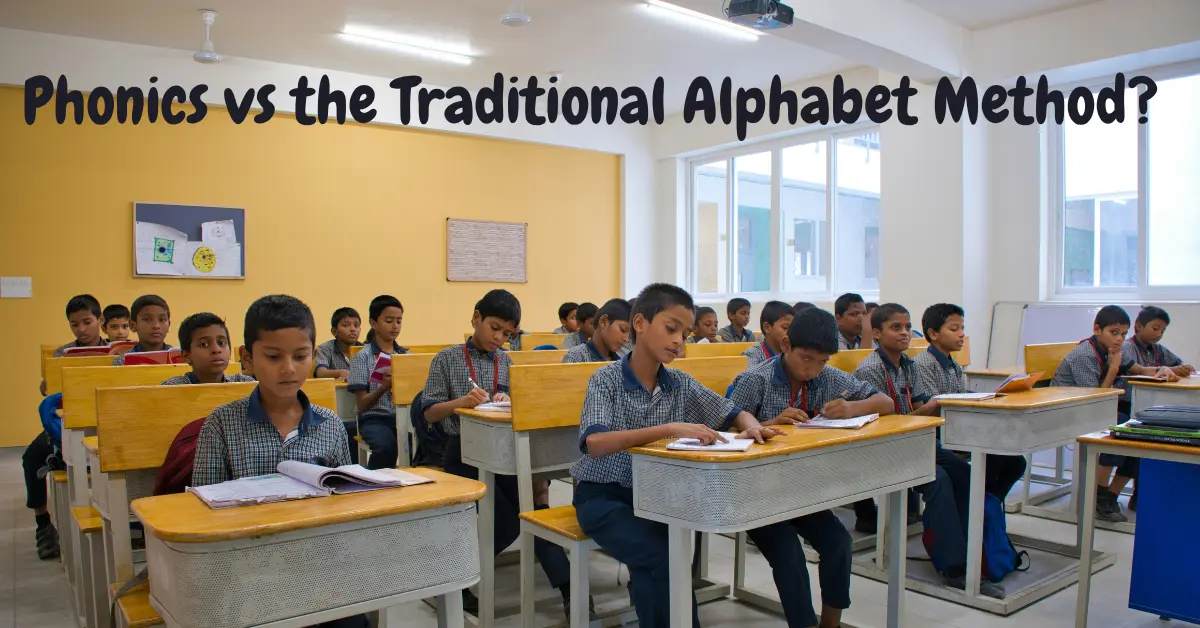
The traditional method — sometimes called the alphabet-spelling method or whole-word method — is how most of us were taught to read, and it's still how many Indian schools approach early English literacy today.
It works like this: children learn the names of letters (A, B, C), then memorise whole words by repeated exposure and sight ("cat" looks like this, "dog" looks like that). Spelling is taught by reciting letter names in sequence — C-A-T — rather than by understanding why those letters produce that sound.
This approach can look like it's working early on. A 4-year-old who has memorised 30 sight words seems like a strong reader. The problem shows up later, when that same child meets a word they haven't memorised before.
What Is Phonics, and How Is It Different?
Phonics teaches the relationship between sounds (phonemes) and the letters or letter groups that represent them (graphemes) — not letter names. A child learning phonics is taught that the letter "c" makes the sound /k/, "a" makes /a/, and "t" makes /t/, and that blending these sounds together produces the word "cat."
The crucial difference: a child taught this way isn't just memorising "cat." They now hold a decoding tool they can apply to "mat," "sat," "fat," "hat," and thousands of other words they've never been shown — including words they'll meet for the first time in a textbook, a storybook, or an exam.
This is the difference between memorising answers and learning how to work them out.
What Indian Classroom Research Actually Shows
This isn't a marketing claim — it's a documented pattern in Indian education research.
A study of children in low-cost government schools in Bangalore found that students who were instructed using the alphabet-spelling method continued to struggle with decoding English words even by Year 5 — a full five years into formal schooling. The researchers pointed to the method itself, not the children, as the root cause: letter names and word spelling were taught without ever connecting children to the actual sounds the letters represent.
Separately, a randomised-control trial examining Grade 2 students in an English-medium school in India compared phonics-based instruction directly against the alphabet-spelling approach. The research was designed specifically to test whether phonics instruction supports English phonological awareness and reading skills more effectively than the alphabet-spelling method — reflecting a wider, recognised gap in Indian English-literacy instruction amid the growing shift toward English-medium education across the country.
The pattern across this research is consistent: children can recite the alphabet fluently and still be functionally unable to read unfamiliar words, because reciting letter names was never the skill that reading actually depends on.
Why NEP 2020 Is Pushing Schools Toward Phonics
India's National Education Policy 2020 introduced the Foundational Literacy and Numeracy (FLN) mission as a national priority — explicitly because large numbers of children were reaching Class 3 and beyond without basic reading fluency. FLN guidelines emphasise sound-based, structured literacy instruction as the foundation for early reading, which is precisely what phonics delivers and the traditional alphabet method does not.
This is also why you're increasingly seeing schools in Pune introduce phonics components into their early curriculum — it isn't a trend, it's a policy-driven correction to a method that wasn't producing independent readers fast enough.
Phonics vs Traditional Method: Side-by-Side Comparison
| Factor | Traditional Alphabet Method | Phonics Method |
|---|---|---|
| Core skill taught | Letter names, whole-word memorisation | Letter-sound relationships (decoding) |
| New, unfamiliar words | Child must be shown and taught the word first | Child can sound it out independently |
| Spelling approach | Recited letter-by-letter from memory | Built from understood sound patterns |
| Time to independent reading | Slower — depends on vocabulary memorised | Faster — one skill set unlocks all words |
| Long-term reading gaps | More common, especially with longer/unfamiliar words | Significantly reduced |
| Pronunciation & speaking | Not directly addressed | Directly strengthened — sounds are practiced aloud |
| Alignment with NEP 2020 FLN | Not the recommended approach | Directly aligned |
"But My Child Is Already Learning This in School" — Addressing the Real Objection
This is the question almost every parent asks us, so let's answer it directly.
Most Indian schools, even good ones, are large classrooms with 25–40 children, limited time per subject, and a curriculum built around covering content rather than building one skill to mastery. Letter-sound instruction, blending practice, and repeated phonemic drills — the things that actually build a reading brain — need small groups, repetition, and individual correction. That's structurally difficult to deliver inside a standard classroom, regardless of how good the teacher is.
This is the gap a dedicated phonics program is built to close — not by replacing school, but by giving a child the structured, repeated, sound-based practice that a 30-child classroom simply isn't designed to provide.
It's also why a school-going child can appear to "know the alphabet" and still freeze when asked to read an unfamiliar word out loud. The alphabet was memorised. Reading was not yet taught.
Signs Your Child Is Stuck in "Alphabet Mode" Instead of Reading
A few quick signs the traditional method hasn't fully translated into real reading ability:
- Can recite the alphabet but hesitates when sounding out simple new words
- Reads familiar words confidently but guesses wildly at unfamiliar ones
- Confuses similar-looking words ("was" / "saw", "bad" / "dab")
- Relies on pictures rather than the actual text to "read" a story
- Struggles to spell words they haven't specifically memorised
If two or more of these sound familiar, it's worth exploring whether your child is ready for a structured phonics program — and the right age to start is earlier than most parents expect.
How Phonics World Pune Bridges This Gap
At Phonics World Pune, our programs are built specifically around the structured, sound-based approach the research above points to — across age-appropriate levels:
- Alphabet Amigos & Bud Level (ages 2–4) — early sound awareness through play
- Bloom Level (LKG–UKG) — blending and early decoding
- Blossom & Intermediate Levels (Class 1–2) — fluency, spelling accuracy, and closing school reading gaps
- Hindi Phonics and Marathi Phonics — the same structured, sound-based method applied across all three languages most Pune children grow up with
Small batch sizes mean every child gets the individual sound-correction and repetition that a regular classroom can't provide — at our Baner, Karve Nagar, and Swargate branches.
Frequently Asked Questions
Is phonics better than the alphabet method for every child?
For the vast majority of children, yes — research consistently shows phonics produces faster, more independent reading and fewer long-term decoding gaps. The alphabet method can work for early memorisation, but it does not equip children to read unfamiliar words on their own, which is the actual goal of literacy.
My child already knows the alphabet — haven't they covered this?
Knowing letter names is not the same as knowing letter sounds. A child can recite A-to-Z perfectly and still be unable to sound out an unfamiliar word. Phonics specifically teaches the sound-letter connection that the alphabet method skips.
Is this the same as what NEP 2020 recommends?
Yes. NEP 2020's Foundational Literacy and Numeracy mission specifically calls for structured, sound-based early literacy instruction — which is what synthetic phonics, like the method used at Phonics World Pune, delivers.
My child is in Class 1 or 2 and already struggling — is it too late for phonics?
Not at all. Our Phonics Intermediate program is specifically designed for children in Class 1–2 who need to close reading and spelling gaps left by earlier instruction methods.
Does switching to phonics conflict with what my child's school is teaching?
No. Phonics complements school instruction rather than replacing it. It gives your child the foundational decoding skill that supports everything their school curriculum already expects them to do — reading comprehension, spelling, and writing.
How can I tell which method my child's school is currently using?
Ask your child to read an unfamiliar word out loud — one they haven't seen in their textbook. If they sound it out using letter sounds, their school likely uses phonics. If they guess, freeze, or rely on pictures, the school is likely using the traditional alphabet-spelling method.
What age is it too late to switch from the alphabet method to phonics?
There is no upper age limit. Our Phonics Intermediate program works with children in Class 1 and 2, and older children with reading gaps benefit just as much from structured sound-based instruction — the earlier you start, the faster the gap closes, but it is never too late to begin.
Will switching to phonics confuse my child if they've already memorised some words?
No. Phonics builds on what your child already knows rather than erasing it. Sight words they've memorised remain useful, while phonics gives them a new tool to decode every word they haven't yet seen — the two approaches work together, not against each other.